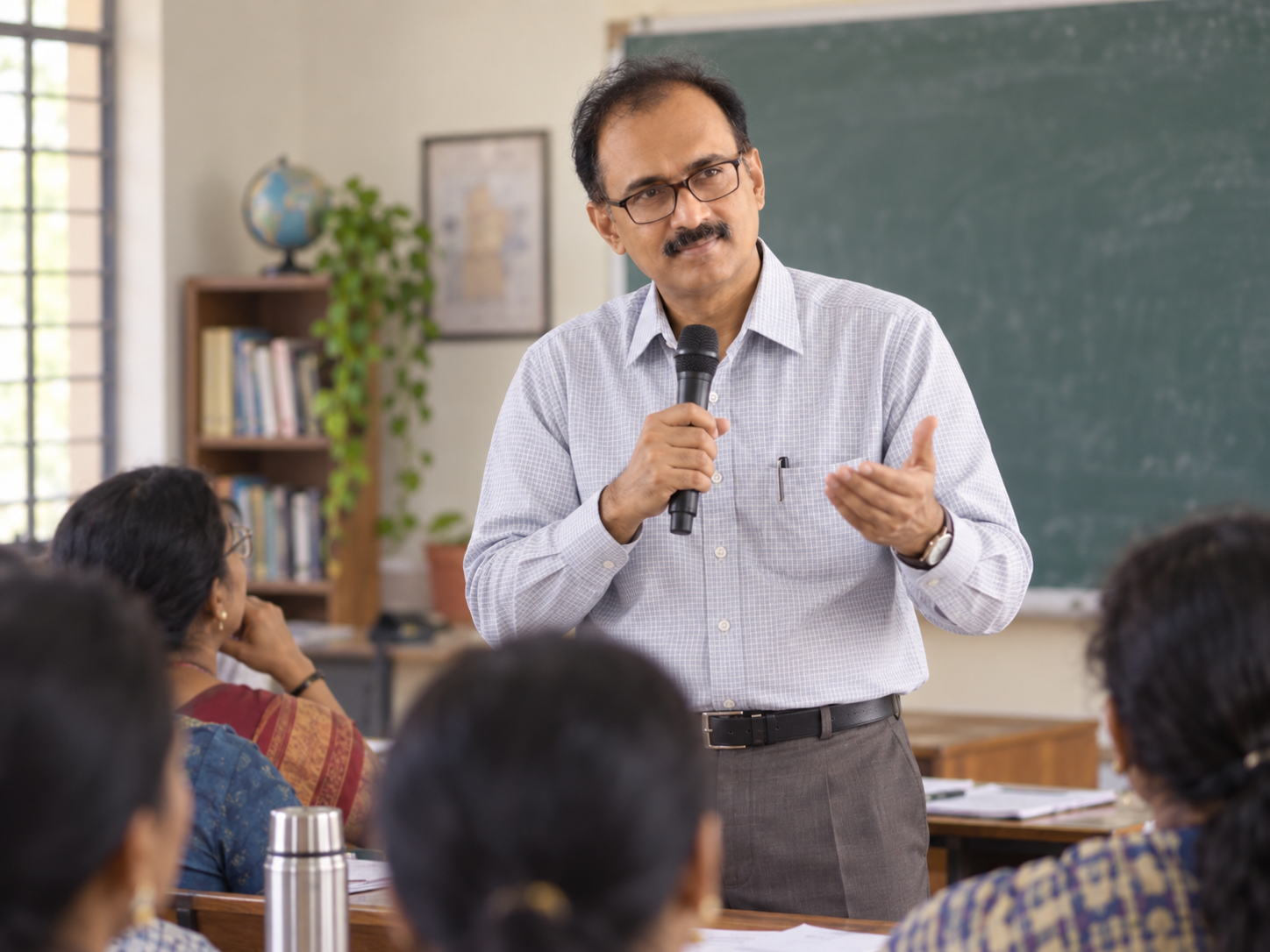
One of the questions that is often put to me is, “What is your advice to teachers?” People who ask me this question may feel that my stint as Secretary of a residential schools society, where we have around 1,500 teachers, qualifies me to answer it. Whether administrative experience alone is enough to answer that question is another matter altogether. However, from nearly fifteen years of close association with teachers and schools in different organisations, one piece of advice I would definitely want to give teachers is: keep learning.
This is an observation born out of my interaction with public schools and their personnel. When I say teachers have to keep learning, it is because of the circumstances in which we now live. It is beyond doubt that ours is a world that is constantly changing. Content is changing, technology is changing, the human interface with technology is changing, and so is social behaviour.
The infiltration of technology into every aspect of life is now a fact. Adapting to these changes has become almost second nature to young learners. Teachers, on the other hand, often have to make a conscious effort to rewire themselves. Quick learning, exploring new areas of knowledge and multitasking are becoming part of life at an unmanageable speed.
In every profession there is an imperative need to learn new things—engineering, medicine, law, agriculture, banking or software. Every profession demands continuous updating if an individual is to stay abreast. But a teacher has an additional responsibility: to keep learning continuously in order to keep students updated.
In spite of increasing access to self-learning tools during the formative years of education, it is still the teacher who can provide the child with the necessary informative and analytical inputs. Unlearning and relearning have become the new catchphrases.
When interactive flat panels were introduced into classrooms in Andhra Pradesh, teachers sometimes took longer to learn the basics of operating them, while students were quicker and could even guide their teachers. There is something instructive in that reversal.
Transfer of ideas and information, and the imparting of analytical and logical skills—to classify, discern and evaluate information before arriving at conclusions—lie at the heart of education. Teachers therefore have to keep learning if they are to impart these skills effectively to their students.
Welcoming new pedagogical methods and strategies can also enliven the learning process. Approaches drawn from areas outside one’s original training—project-based learning, for instance—can give teachers additional tools.
Retaining curiosity, inquisitiveness and an attitude of enquiry is central to the learning process. More than anything else, this is what rejuvenates a teacher.
The day you stop learning, you are like dead wood, a meal for the termites in the future.