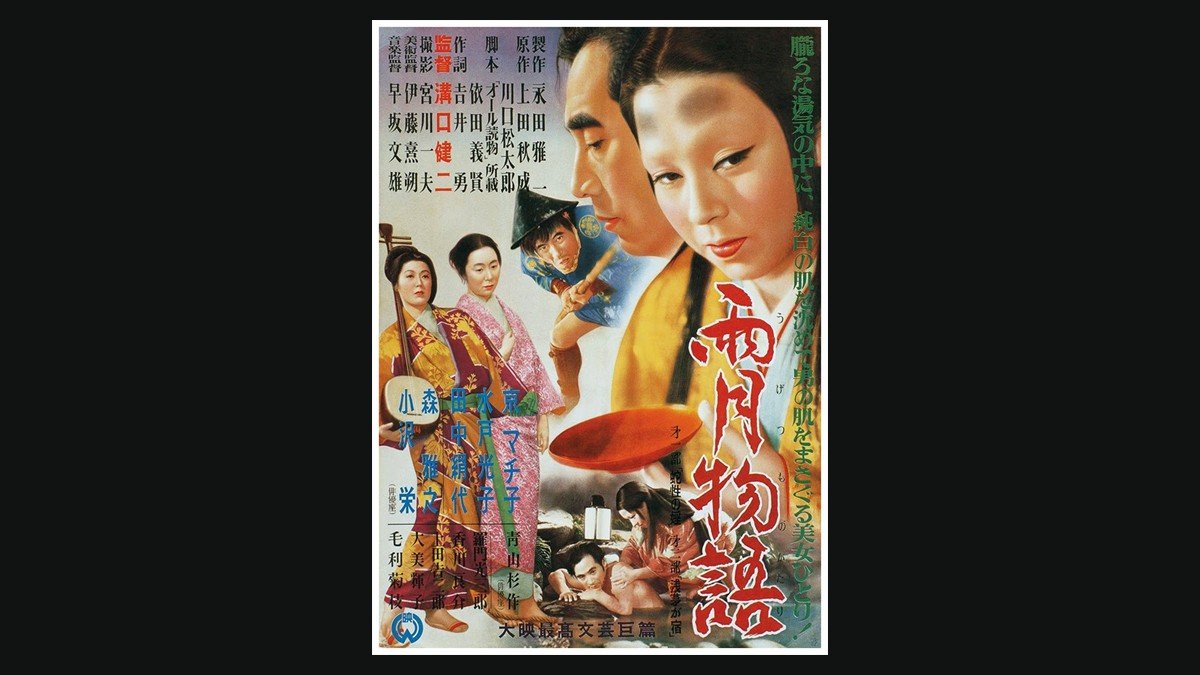
Watched the movie Crucified Lovers by Kenzu Mizoguchi. Ugetsu Mongotrai, Sansho the Bailiff, Life of Oharu are all films by Mizoguchi that I had watched earlier. Japanese films of that era especially those of Mizoguchi and Yasuziro Ozu maintain a certain translucence and poise that is unmistakable. Kurosawa’s Rashomon and Yojimbo also have this quality.
Movement, splendor and pageantry dominate films like Ran, and Kagemusha. However coming back to the quality that I most admire in the films of Mizoguchi and Yasujiro Ozu ; it is the total adherence to the classical concept of unities ; unity of thought and unity of action.
Crucified Lovers is the story of Madam O San, the wife of a rich but niggardly printer of records and his chief apprentice Mohei. Mohei’s unspoken love for Madam O San is such that he will go to any extent to fulfill Madam’s wish; even forge a receipt to bail out Madam’s brother from financial trouble. Mohei’s goodness doesn’t let him complete the act and he confesses this act he is about to commit to his master. He is imprisoned – O Tama the servant maid protects him saying it was for her sake. Mohei escapes from his cell and goes to find O Tama to thank her for her gesture only to find O-San in the maid’s bed.
O San is there to confront her husband who has been harassing O-Tama for sexual favors. In search of Mohei, the master discovers Mohei and Madam in the same room in a very emotional state and accuses them of adultery. Disgusted with her husband’s disdainful attitude, Madame O San leaves the household to find Mohei who has been wandering the night streets. From that moment they become the Crucified Lovers.
Madam only wants to go her way, may be even commit suicide. But at the moment they are about to drown in a river, Mohei’s feelings well up and he confesses his ardent love for O-San. The strange turn of events help in unraveling Mohei’s love for Madam O San and the scenes progress towards the cementing of this bond and the unifying of these two star-crossed lovers whose fortunes have brought them together under the most peculiar circumstances. They are discovered and charged of adultery. According to the laws of feudal Japan, for this capital crime the lovers are paraded through the streets en route to their crucifixion but are happy and blissful, in hope of eternal repose, and freedom from the world of sordid machinations.
Coming to the theme I would say the movie is an exploration on the theme of fidelity. We have a husband who is inhuman and unloving and treats his wife as a ceremonial show piece. We have O-San the madam who is chaste and generous, bound by custom to the role of a faithful wife. We have Mohei who is constant in his love for O-San and O-Tama whose simple love for Mohei is unquestioning. Mizoguchi achieves a choral quality with his tale, infusing the narrative with asides and comments from the house hold and also with a tone that doesn’t dilute the mood of high seriousness. Mohei is faithful to the family honor but Sukeimon the other apprentice is unfaithful to the family honor, colluding with the competing printer.
The narrative has the mythic quality of a fable; a loving father of Mohei , an indecisive mother of O San, the scheming merchant and the crucified lovers whose pure love shines through with an inner power and purpose once their hearts are united. The last scene is memorable; they are in confrontation with the world. They are tied together to their back. They cannot see each other but their hands are held tight, perhaps a symbolic gesture of the spirits which are locked forever in a harmonious bond.