As I returned from Trivandrum, I felt an absence, a vacantness. I had spent four days seeing and discovering new places. Return to home meant return to work, return to dreary routine and getting immersed in the day-to-day business of living. One doesn’t like to return quickly, especially if it is from a place like Kanniyakumari. It is India, but still it is a part of India to which I had not been before and to which I may not go again very soon.
Is it the end of land? No, certainly not. You will certainly meet land if you sail for a few hours. But the thought of standing before a vast, azure-blue sea, stretching endlessly into the horizon, is intoxicating. Interspersed with the notion of India’s unity, this sight of Cape Comorin was a thrilling prospect. The sunrise and the sunset, the primitive elation of the people who have come to watch this magical scene, need no explanation except that it is exquisitely beautiful. We were guided constantly over the phone by Dad, who had made umpteen trips to this place during his railway career.
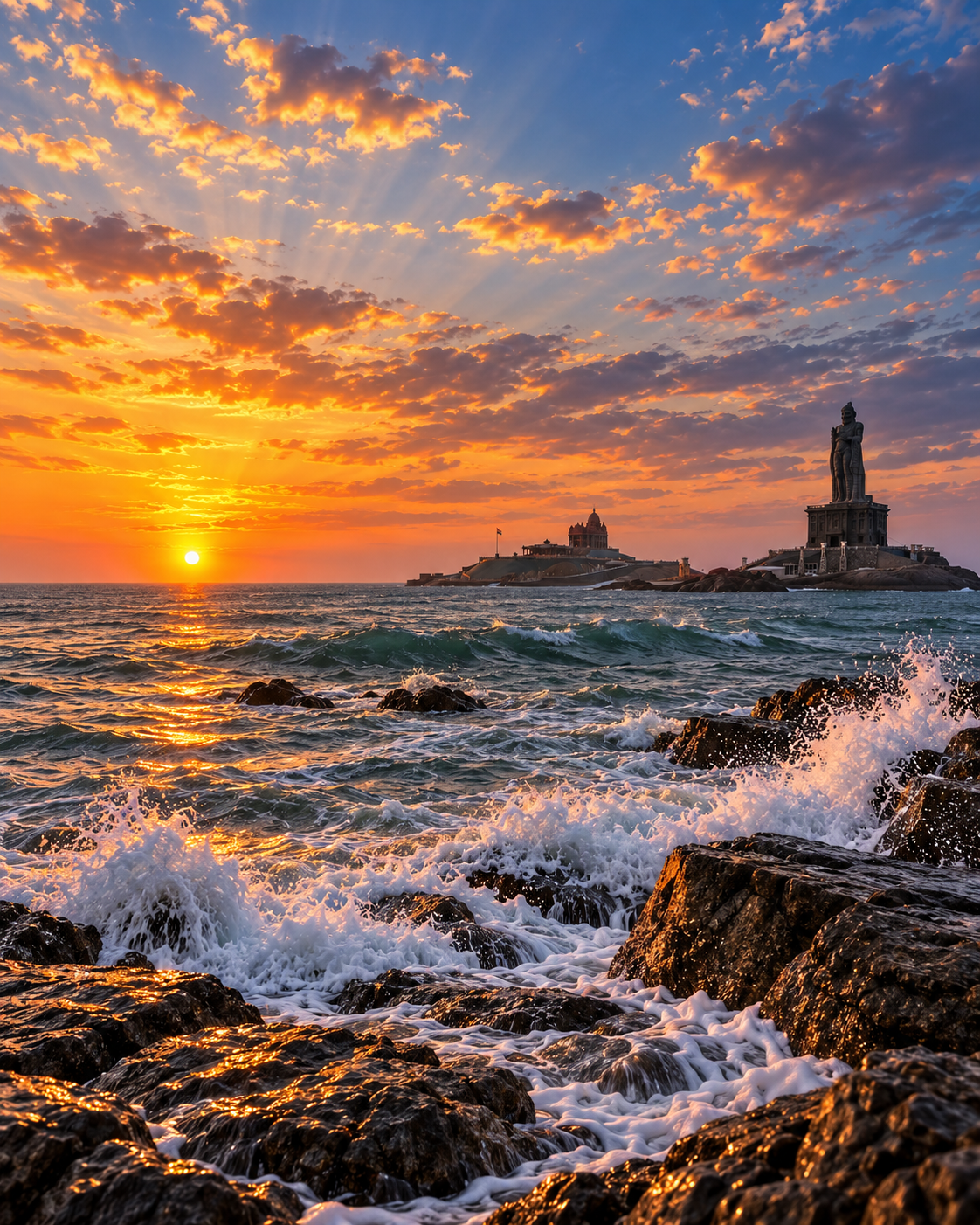
Having visited Kanniyakumari, Gandhi wrote, “I’m here before the Cape, before the end of land. The coast here is not a port of call for the vessels. The waters here are virgin like the virgin goddess.” Noble thoughts. Among all the tourists, the euphoria was unmistakable. As people bathed and sprinkled drops on their heads, the mythical fixation with water and purity was palpable. This is one place where you could say, I have reached the southernmost point of India. At 6 p.m. the sun plays hide-and-seek, now sheltered by the clouds, now glowing in splendid refulgence. It is not a perfect sunset. Yet it is enough for me to treasure the sight.
For me, the process of meeting other people and hearing other languages was more thrilling than the visits to the tourist spots. In the evening, the cool breeze from the sea and the devotional songs in Tamil made me nostalgic and think as to what is so unique about Kanniyakumari. Did Swami Vivekananda make Kanniyakumari more famous than it actually was? He reached there in December 1892 and swam the ocean to meditate for three days on a rock. Perhaps he needed this hallowed spot to discover something about himself, something about India that needed to be announced to the world. The sea here has such magnificent power. The mystical confluence of the three waters — from the Bay of Bengal, the Indian Ocean and the Arabian Sea — surges into the rock, thrashing it with mighty force and turbulence. Far ahead I could see a launch boat being buoyed by the waters, just like a painted ship on a painted ocean in the Mariner’s tale.
We travelled from Kanniyakumari to Trivandrum by bus. Trivandrum is a green city. It has been selected as one of the ten greenest cities in India. Every house has at least ten plants in its compound. There aren’t many apartments around. We visited Kovalam beach and the Padmanabhaswamy temple to worship Lord Padmanabha, reclined in the sanctum sanctorum. Everywhere there is an aroma of sandal, coconut and camphor that is unique to Kerala. Legend and architectural splendour vie with each other to add a touch of mystery to this temple.
The next day we went to the Veli tourism park to have a peek at the backwaters and a lagoon stretching from the Arabian Sea. We could spot woodpeckers, vultures, storks and cranes. There are some beautiful trees in this place. We visited the Napier art gallery. The best pieces on display are the ivory carvings. At the Chitra art gallery, there is a breathtaking array of paintings by Ravivarma, Nicholas Roerich and Svetoslav Roerich. A beautiful piece of Radha and Krishna on a swing in a garland of ivory must be the chief attraction.
The Trivandrum Zoo was more interesting because of the marvellous landscapes and woods that adorn this place. There are small forests of tall bamboos here and there and a rivulet of backwater flowing serenely through the forest. The ancient trees make a canopy of shade in their splendid tallness. There are several cool enclosures which give the tired visitor a feeling of otherworldliness. We left Trivandrum at 4:20 p.m. by the Anantagiri Express. It rained when we were there. The next morning was grey and balmy. Trivandrum appeared to be unhurried and laid-back, unlike Hyderabad where the bustle starts as early as 8 a.m. Can we get to know a place, a people? Curious and stirring, I tried to find some answers.