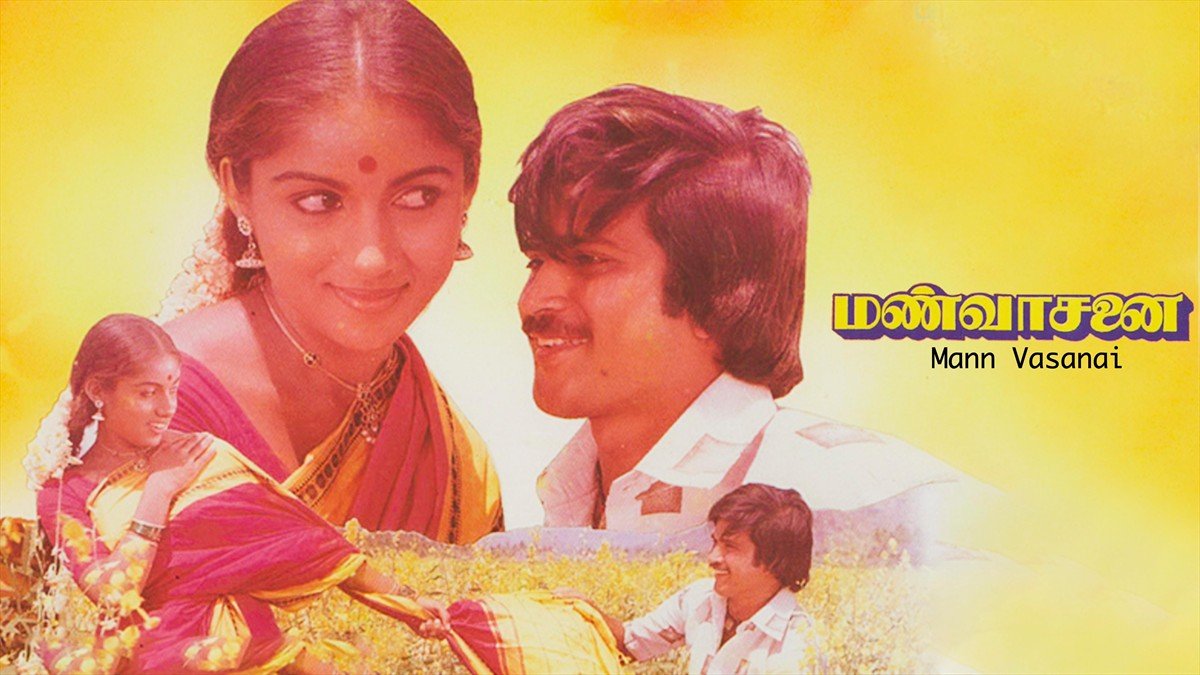
During my school days in Chennai most of my Tamil friends would rave about the films of Bharathiraja and wait eagerly for the release of his films. Some of their enthusiasm rubbed on to me and I would accompany them to the theaters to watch the films of Bharathiraja. Although I did not understand Tamil very well at that time, the films of Bharathiraja were very special for me. Unlike other thrillers, action oriented movies; his films were weighty, laced with emotional content with stories from the grassroots. His films evoke the earthiness, rustic charm, the ebb and flow of rural life in Tamilnadu. Two of his films are close to my heart; Manvasanai and Mudhal mariyadai. The first one was remade in Telugu as Mangammagari manavadu and the second one was dubbed as Aatmabandhuvu. The focus in the Telugu titles shifts to persons and heroes whereas in the Tamil original the titles suit the mood of the films. In both the films the cinematic canvas is alive with the scent of rural Tamilnadu. Perhaps no Tamil film Director has portrayed the rural landscape of TN as Bharathiraja. Manvasanai (the scent of the soil) deals with issues of identity, matrimony, gender equality, village politics and love.
Muthupechi’s (pearl speech) father is proud of his warrior lineage and his bull. In a state of intoxication he is egged on by the chieftain of another village to bet that he will give away his daughter to the person who can tame his bull. Using foul means and drugging the bull, the opposing party wins the bet and claims the hand of Muthupechi. However Muthupechi is betrothed to her uncle Veranna. Bewildered by the turn of circumstances, Muthupechi’s father kills the bull and himself. What began as a moral aberration by a wayward male turns into a village feud as both the villages are adamant on establishing their control over the life of Muthupechi. She becomes a symbol of honor, a battleground where one side wants to fulfill the bet of the dead father and the other to wed her to her Uncle. After a deadly fight, Veranna runs away from the village. He joins the army and marries a North Indian girl. The issue is left smoldering but when Veranna returns from the army with his wife, the question of Muthupechi’s matrimony is raked up once again. Muthupechi declares that she is no longer interested in marrying her Uncle, to be his second wife. The entire village including her mother is shocked by this independence and the family is cast out of the village. A girl’s identity (rather commodification) is the ground where the honor of individuals and villages is staked. Her identity is a mere passport to be exchanged.
Muthupechi’s world is her betrothed Veranna. Her love is pure, tender and sincere. Bharathiraja’s vision lovingly captures the eagerness and frustration of the lady as she awaits the return of Veranna from the army. (The images of free flowing birds, the breeze, the winding grass stalks are simply captivating) It is the scent of the soil which has seen many a story like that of Muthupechi and Veranna. Courage, chivalry and passion belong to the male but does Muthupechi not have a voice?
Mudal mariyadai or first etiquette portrays the life and history of a man (Sivaji) who is more sinned against than sinning. To protect the family dignity and to save his Uncle’s honor, he marries his daughter who has had an affair and conceives outside wedlock. This loveless marriage becomes worse as the wife proves to be remorseless, unrepentant and vindictive. Sivaji keeps the secret locked in his heart but treats his step daughter with love and affection. However his life of song, music and poetry can never find solace inside the hell that is his home. He finds joy in the song of the birds, the grass stalks, the rice fields, the Sun and the Earth. Kuil (Radha) a new entrant to the village becomes his soul mate. The naturally playful and vivacious Kuil gives him what he is missing in life; joy, romance, challenge and thrill. Their platonic relationship blossoms into a deep friendship. After a gap of two decades when the paramour returns to the village in search of his teenage heartthrob, Kuil who values the honor of her friend kills the wife’s lover while he narrates his love story. The film ends with Kuil being brought from prison to see her friend on his deathbed. The film calls out artifice and grossness and seems to celebrate innocence and ingenuousness ; both a part of Nature. Both films have extraordinary music by the maestro Ilayaraja. Undoubtedly the films belong to the golden age of Tamil cinema when rural themes and stories of innocent villages captivated the audience compared to the glitz of high octane drama and drug frenzy ruling the screens now.