Two hundred and ninety-seven kilometres from Ahmedabad by train lies Udaipur, the picturesque city of lakes. Travellers to this city usually take a tourist coach which takes them there within seven to eight hours. But the experience of going by the Mewar Passenger, which starts at Ahmedabad at 7.20 in the morning, is unforgettable. A stroke of fortune made me miss all the tourist coaches, and I could get into the Mewar Passenger. Early in the morning, Ahmedabad railway station was clouded in mist, smoke and sleep. Our cab from Anand was just in time, and we crossed the broad-gauge section to reach the metre-gauge part for the Mewar Passenger.
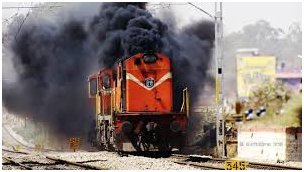
With barely ten coaches and a steam locomotive, the train became for me the first sign of a passage into a placid, old world. It takes the train less than one hour to get out of the smoky surroundings of Ahmedabad. The first major station on the way is Himmat Nagar Junction, where the train stops for coal and water. From here starts the breathtaking part of the journey. As if out of nowhere, the train starts ascending into the mountains, and soon the travellers cannot help marvelling at the rugged majesty of the Aravallis, the mountains of north-western India. One hour after Himmat Nagar, the train enters Rajasthan, stopping at small stations all along. To the traveller’s surprise, there is nothing on this route that one can get to eat except packed, company-made biscuits. At Durgapur, women come selling fresh channa.
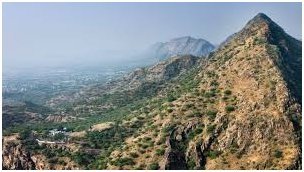
Coming to the journey, one can see the hills all along. They have a forlorn look, sparsely populated, with only a hut here and there. Small lakes lie sleepily between two or three mountains. A herd of camels laze under a strip of shade, beating the afternoon sun. Now and then, a beaming face emerges out of thick foliage of leaves and branches, and numerous working hands take a break to wave slowly at the passing train. All these scenes are quickly eclipsed as the train curves along a winding track, entering a tunnel and emerging into lashing daylight from pitch darkness.
One can see an occasional black monkey or a peacock. The mountains go up to a long distance away from the track, merging indistinctly into the horizon. The blazing sun lights up the mountains in the afternoon, giving them a violent red hue. The flame of the forest, in thick red colours, is everywhere, adding beauty to the brown, sun-burnt landscape. After the coal dust from the locomotive, the idyllic wayside stations of the region, the friendly Rajasthanis and a wayward camel, the train slowly puffs into Udaipur station by five in the evening.
Udaipur compels the traveller to recognise the quietness which is everywhere. In spite of the bustle, the screams and howls, the rush of peak-hour traffic, Udaipur retains a silence which any sensitive person can easily see. An old wall, the remains of a fort, greet us just outside the station. Tongawallas are there too, ready to unwind the tales of yore if only one shows interest in listening to them.
The auto I took went through winding lanes, and I reached the place where I was to put up for the next two days. Business seemed to be vigorous but quiet, as everybody appeared to be zealously guarding the placidity all over. At the junction in the evening, I could see college students who were excited about some affair, but rather calmly. By eight o’clock I could see a brilliantly illuminated Jaisamand, Lakeview Hotel, Namichama Temple and Sajjan Ghad.
There are too many things to be seen in and around Udaipur, but I opted to see only those which I could in a day. Nathadwara, 50 kilometres from Udaipur, where the temple of Srinathji, the deity of Rajasthanis, is located, is a place of pilgrimage. Jaisamand, 15 kilometres from Udaipur, offers a spectacular view of a mighty fort on rocks, from where one takes a long gaze into infinity.
The next day for me was hectic. I started at 8.30 and decided to cover as many places as I could. Udaipur abounds in lakes and parks. A curious traveller will, however, spend less time at these places in favour of the enchanting Lake Palace and other temples around. My first stop was Namichama Temple, located on the top of a hill. Devotees have to climb the steps to have a darshan of the Devi. From there one can take an excellent view of Udaipur, and not without reason is Udaipur called the city of lakes. I could see four fine lakes around and a small city embedded in the space between many big hills.
The amazing scene enchants the traveller—the sight of the silent white structures beneath, merging into the slight toll of the temple bell of a devout devotee. At the back of the mountain, a family was talking about Rangoli on DD, it being a Sunday. But it didn’t in any way distract me from the other sights around: an old Marwari lady puffing and fretting while climbing, and young girls washing the fantastic red and black flowers they had collected under the fountain.
After a brisk descent, I moved on to see the Lake Palace, formerly Jag Niwas, built and extended by different kings of the Mewar dynasty. Though not a very imposing structure, the Lake Palace, without any arrogant additions, stands peacefully, the tales and stories of the ages wrapped in its folds. When the lure of beauty and the initial euphoria fade away, one can recognise the Hawa Mahal palace, silently holding forth the delicate lessons of history.
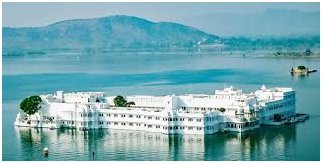
For those who want to take a journey into the past of this medieval palace, it is good to employ a guide. Each window, corridor and wall in this palace has an interesting story to tell us. A small museum inside the palace has artefacts from the fifth century B.C. to 1700 A.D. on exhibition. The splendid etchings on the walls, picturesque paintings of the brave deeds of King Rana Pratap and the historic turban of Shah Jahan were all there for us to see.
As I took my time marvelling at the beauty of the palace, I was silently led into the delightful mystery of Udaipur. The small balconies from the corridor, from where I could see the Lakeview Hotel or the Hawa Mahal, made them appear like ships on still waters. The delicately carved windows placed right next to these balconies also offered this spectacular view from a different point. As the day progressed, sunlight dabbled with the palace, giving it different colours and adding a tinge of glow to the radiant rooms. A good view around took me up to three hours, and in the afternoon I returned to our rooms. After a short rest, I set out in the evening, walking slowly around the junctions of the city.
An important place in Udaipur was yet reserved for me. I was to discover its magnificence only after the evening, in the first soft shades of the moon. The Srinathji Temple in Udaipur city was my last stop. It was by a real stroke of luck that I could visit this temple, as some friends suggested going around the bazaar, which was turned down by a few of us.
Once again I came out enriched, absorbed by the legendary aura of the imposing structure. The day began in that tranquil Udaipur fashion, and now it was ending too, slowly, in the confines of the Srinathji Temple. I watched, awestruck, the minute workmanship on the walls of the temple and at once could sense a fleet of memories tumbling across from the past—the toil, the sorrow, the happiness and the celebration of it all. It was with a feeling of puzzled sadness that I came out.
Afterwards, I quietly traced my way back to the lodge, trying to treasure forever as many impressions as I could from this short visit to Udaipur.
Conceived as a travel piece, this article took on the character of a script mainly because of the romance of a train journey across the Aravallis, which evoked for me images of Phileas Fogg’s train travel in Around the World in Eighty Days.