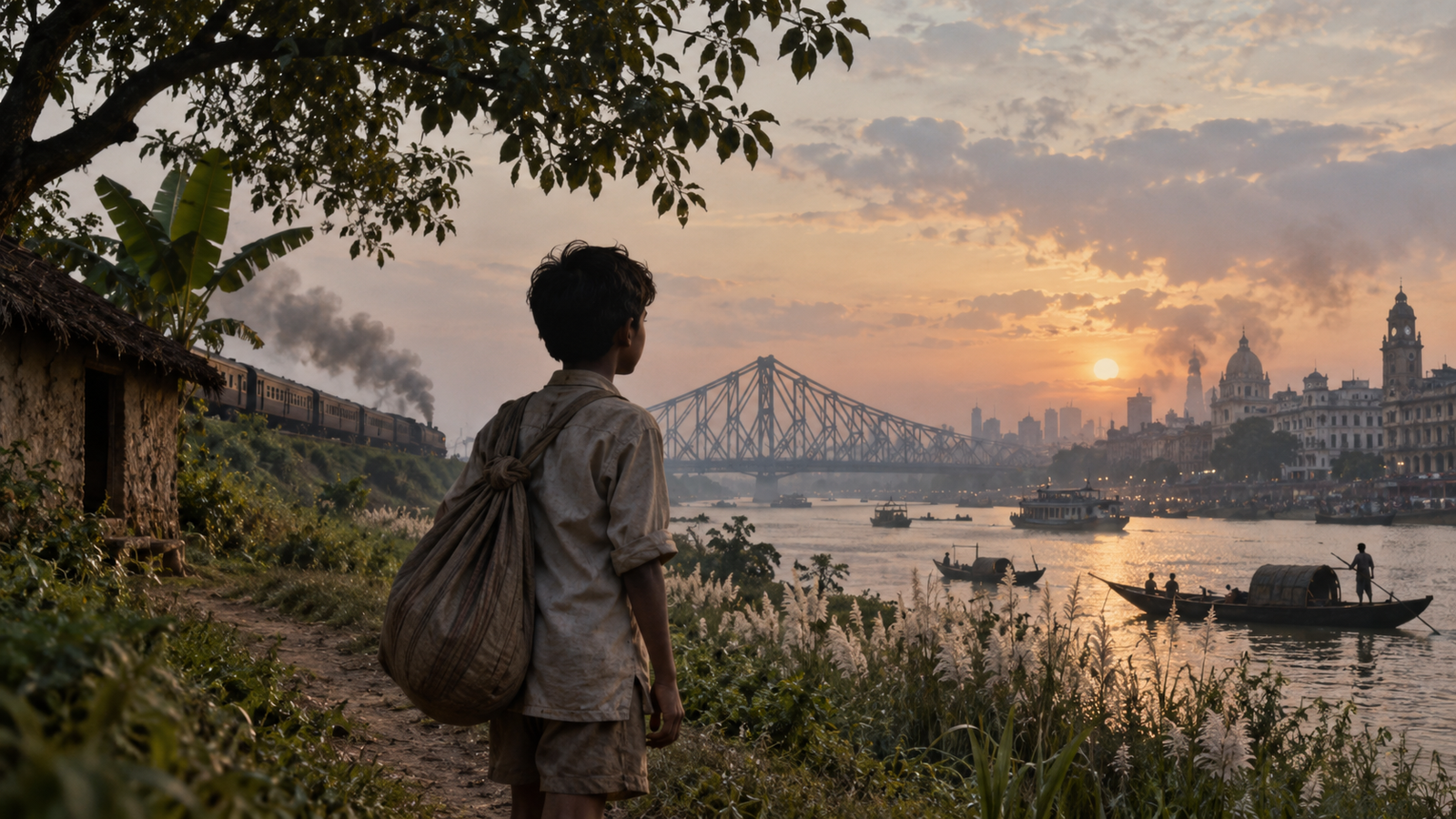
Kanchan is the only child of a headmaster in a village school. He is young, playful and has big dreams of going into the world and exploring its wonders. His mother shields him as often as she can from his father’s strict eye. He is a disciplinarian and punishes Kanchan for his naughty quarrels and tricks. After a quarrel with the priest’s son Kanchan expects harsh punishment from his father and runs away from home to Calcutta, the city of riots; aptly summarized in the words of a poor laborer who gives Kanchan a meager meal. “Calcutta is a city. Nobody cares for your anger in the city!”
When Kanchan reaches Calcutta, he understands the social reality around him. The city is heartless, cunning and exploitative. The way he loses his shoes, or how he is stopped from hauling coal from the yard, the harsh treatment meted out to the old maid by the mob, whose only mistake is to look for her lost son, or Haridas who has lost his job as a teacher post partition and now ekes out his livelihood selling roasted nuts, or the shirtless boy who is kidnapped by a gang. The city has its share of good people too; the hotel owner who lets off Kanchan with a slap for breakfasting on the house, the tram conductor who gives a free ride, the old lady who offers Kanchan a meal and Mini’s family who show real concern towards Kanchan.
Calcutta in its myriad hues is pictured in the movie, the slums and the shacks, the poverty and the misery alongside the grand roads and bridges of Calcutta are all captured on the screen. Ritwik Ghatak’s modernist style infuses the film with what it essentially proposes to do; the joy of discovery seen from a child’s eye but also the frustration and dejection as Kanchan realizes that his ambition of earning big money is only a dream, more so in the city.
Mini’s mother is ill. After a dreadful might in the open, Kanchan makes up his mind to go back to Mausi-Mini’s mother. He learns that during his brief absence, Aunty has passed away.
This is where he decides to go back again to see his mother. A mother’s love prevails over his ambition and as he returns home, he reconnects himself to all that is his; the boat, the river, the fields and an emotional reunion with his mother; In a way the Runaway is ‘back at last’. The film doesn’t denounce the city but vividly contrasts the village with the city, the quiet with the bustle the love with the commerce etc. Altogether a child’s film from the oeuvre of Ritwik Ghatak, who treats the subject with grace, compassion and empathy. A must see in the class of Aparajito.